Friday, April 15, 2022

Miss Izannah Walker's Celebrated Cloth Dolls

    ©  Kathy Duncan, 2022

The charming dolls made by Izannah Walker are my heart's desire. Or a reasonable reproduction. In reality, I can't afford to have either one on my bucket list. Researching Izannah and her dolls, however, is well within my budget.

I do not have access to any pictures of Izannah's dolls that I can post here; however, if you have never seen her dolls, please take a moment to view them on Paula Walton's blog or Dixie Redmond's blog

I set out to research Izannah in the same way that I researched the quilter, Jane Stickle. This time, I am working through the lens of a genealogist who loves Izannah Walker dolls. My intention was to compare what is known about her to what the available online records reveal. So far, I'm pleased with the results. If you are an Izannah fan and enjoy reading every tidbit about her that you can find, grab a cuppa and tuck in. This might be longish. Much of it you may already know, but I promise there is "new" information as well. And perhaps a paradigm shift in your thinking about Izannah's doll production.

My first step was to check for Izannah Walker on the Family Search's shared family tree. I found her there, but no one had ever attached any census records to her. That seems odd, but Izannah's name makes it a challenge to find her in records. I attached the following census records to her: 1850, 1860, 1865, 1870, 1880, and 1885. Additionally, I had to add Izannah's aunt Jane Hellon (Swasey) Hintz to the shared family tree, and attached census records for Izannah's sister Jane H. Walker. You can view all of these original census records yourself if you will create a free Family Search account. Then follow these i.d. number links for each woman: Izannah Walker L265-881, Jane H. Walker MV3Z-HM2, and Jane H. (Swasey) Hintz G6P5-4FZ.

Izannah F. Walker was born in Bristol, which is documented on the 1885 Rhode Island census. The confusion begins over trying to determine if she was born in Bristol, Rhode Island or Bristol County, Massachusetts. The 1885 census says Massachusetts, so it would be Bristol County, Mass. However, other census records also record her state of birth as Rhode Island. I do know that her father Gilbert Walker was frequently placing advertisements in the Providence, Rhode Island newspapers, which noted that he was in Somerset, which is a town in Bristol County, Mass. Izannah's age varies widely from census year to census year as does her sister's age. On several censuses, Izannah's age would have placed her birth year closer to 1820 than 1817. In searching for individuals on the census, keep in mind that census information is only as reliable as the person providing it and might be provided by proxy. In other words, one household member might provide information for everyone. Even a neighbor could provide information if no one was at home that day. To find Izannah on the census, I widened the bracket for her birth year and varied her state of birth. I identified her by other occupants of her household - family and friends.

We know from various secondary sources that Izannah's parents died when she was young. Her mother died in 1824:


And her father died less than a year later: 


I believe that at the time of Sally and Gilbert Walker's deaths, the family was living in the vicinity of Bristol, Rhode Island. Tradition tells us that the Walker orphans were sent to live with relatives in Somerset, Mass. Keep in mind that Providence County, Rhode Island, and Bristol County, Massachusetts "border" each other even though they are also separated by a waterway. Traveling back and forth between the two locations would have not been a problem. People in that time period traveled much more than we give them credit for.

The 1850 census locates 28-year-old Izannah F. Walker in Somerset, Bristol County, Massachusetts, living in the same household as her aunt Jane Hintz, age 54; her uncle Robert Swasey, age 60; and her sister Jane H. Walker, age 30. The only household member with an occupation was Robert Swasey who was a painter. It's impossible to know from the census what type of painter he was. House painter? Mural painter? Portrait painter? Did he teach the Walker sisters and their aunt the painting techniques that they used on their dolls or was he the source for their oil paints? 

Edit: Jane H. Hintz can be found on the 1855 census for Bristol County, Massachusetts, living with her brother Robert Swasey. However, I have yet to find Jane H. Walker or Izannah F. Walker. Izannah may have been in Rhode Island by this time, so she would not have been included in the Massachusetts census. There was an 1855 for Providence, Rhode Island, which is missing volumes. I searched it page-by-page, but did not find Izannah F. Walker, Jane H. Walker, Mary C. Bragg, or Emeline Whipple. Either the pages they were on are missing, or they were not living in Providence, RI at that time. 

Two delightful, circa 1855 photographs feature little girls with their Izannah Walker dolls. Both girls were residents of Providence County, Rhode Island which argues for Izannah having made her move to that area by 1855ish. The girls were Clara Eady and Mary Ella Jenks. Of the eleven or so period photographs that I have found of little girls with their Izannah Walker dolls, only these two girls have been identified. Additionally, future doll maker Martha Jenks (Wheaton) Chase, who was born about 1851 and was a resident of Pawtucket, Rhode Island, received an Izannah Walker doll as a young child.  

Izannah was definitely in Rhode Island by 1860, when she appeared on the census in the township of Smithfield in Providence, rooming with 53-year-old Mary C. Bragg. She was likely to have been living in the village of Central Falls, which is located within the township of Smithfield. On this census, Izannah is listed as being 40 years old, which would shift her birth year to 1820. One extremely interesting detail is that Izannah owned $500 worth of real estate. That land deed might shed some insight into the year that she arrived in the area. Many are under the impression that women did not own property in their own names and that their property was owned by men instead. That is true of married women and daughters. Their property was legally held and controlled by the men in their lives - husbands and fathers and sometimes brothers. Never-married women and widows, however, did own property in their own right. It's one of the primary reasons why widows with property inherited from their husbands often did not remarry. Izannah Walker, as an unmarried woman with no father to dictate her business, was a free agent. 

The 1865 Rhode Island state census for Central Falls, Smithfield township, Providence County, Rhode Island, is the only one that lists Izannah F. Walker as a doll maker:


In 1867, Izannah was living at 11 Jenks in Central Falls, RI. 


On the 1870 census, 50-year-old Izannah Walker was rooming with her 44-year-old friend Emeline Whipple in Providence, RI. They seem to be boarding in the Martin household. This time Izannah is "keeping house" while Emeline is listed as a "doll maker." Izannah does not have any real estate at this time, but does have $200 in personal property. Personal property on the census means portables. Everything we know about Izannah indicates that she was in the doll business at this time. Emeline could have been participating in any phase of the process: body making, sewing clothes, or, painting - or possibly all of these. It is extremely interesting that a significant number of men in the neighborhood are listed as machinists. Any one of them could have helped Izannah in developing her doll manufacturing device. She was surely working on it during this timeframe. I had thought that I might find other women listed as doll makers and that would indicate that Izannah might be employing them. I did not find any nearby, but I did find dressmakers and seamstresses living in the vicinity. They may have been participating in Izannah's doll making, it's impossible to say.

While it is possible that Izannah received help from Reuben Bates, who was likely the pattern maker who crafted her doll head molds, she would have also been surrounded by neighbors who could have also contributed their knowledge. 

We know that Izannah applied for her doll manufacturing patent in 1873. The PDF for Izannah's patent was created by Dixie Redmond. When the patent was issued, there was a notice in the local newspaper. Note that in this notice Izannah is referred to I. F. Walker. Initials were popular for men's names and concealed the identity of women. When researching with old newspapers, remember to search by just the individual's initials.


One year later, during the Christmas season, E. W. Billings of Providence, RI published an advertisement solely devoted to promoting Izannah Walker's dolls. Note that E.W. Billings is offering the dolls wholesale, which suggests that he is selling them to other merchants although he would probably also be selling them to individuals. Significantly, he states that he has been Miss Walker's "agent for so many years." That suggests that he was carrying her pre-patent dolls for at least a few years. That would seem to include the year when Izannah and Emeline Whipple were on the 1870 census, and Emeline was the "doll maker" of record. Could two women alone supply a wholesale doll trade of enough significance to warrant an exclusive advertisement four short years later? I would contend that this must have been a larger operation than two individuals could keep up with. Izannah must have been employing others in some capacity. It's possible that her aunt Jane Hintz and sister Jane H. Walker were participating from a distance in some capacity. It's even more likely that Izannah was employing women in her area. 

Unlike the toy trade now, dolls and toys were mostly advertised and stocked in shops during the Christmas season. No doubt, Izannah and Emeline spent the whole year preparing for Christmas sales. 


I am taken with E. W. Billing's terminology: "Miss Walker's Celebrated Cloth Dolls" which were also "The Everlasting Cloth Doll." Everlasting is a term that I tend to associate with Greiner dolls. 

So far, I have not found any references to Walker's cloth dolls in E. W. Billings advertisements prior to 1874. He did mention that he stocked cloth dolls, but only in a generic sense that he advertised china, wax, and rubber dolls. Walker's local notoriety, following her patent, may have resulted in this shift in his advertising for her dolls. 

There is no doubt in my mind that the advertisement above refers to Izannah Walker and her dolls. Seven years later, in 1881, the firm of E. W. Billings, headquartered at the Butler Exchange, was still the agent for Miss Walker's cloth dolls. This advert makes it clear that the dolls were offered for both the wholesale and retail trade. Note that the dolls were offered for the "reduced" price of $3.75. In 2022's U.S. currency, that would be close to $110. Or approximately, the same as purchasing an American Girl doll for the daughter of a comfortable middle-class family. Dolls at this time were sold both dressed and undressed, which dictated their price. The size of the doll also dictated the price with larger dolls selling for more than smaller dolls. Izannah's dolls ranged from 13" to 29". 


Also, in 1881, E.W. Billing's stated that he had "a stock of Miss Walker's cloth dolls this season, their chief merit consisting in their ability to stand rough usage and abandonment serenely." This is not unlike Izannah's description of her dolls as "easily kept clean and not apt to injure a young child which may fall upon it. It will preserve its appearance for a long time..." 


The Butler Exchange, where E.W. Billing's firm operated in Providence, Rhode Island, was an imposing structure that would have housed several businesses. It comprised a commercial block in a port city known for extensive trade. From this point, Izannah's dolls could have been purchased by merchants at a considerable distance from Central Falls. They could have been easily shipped by rail or by ship. 


E.W. Billings was Edward Woodman Billings of Providence, Rhode Island. Billings was a wealthy merchant who died in 1877. Evidently, the firm continued for several years after his death and continued its relationship with Izannah Walker. 

The importance of this business arrangement with E. W. Billings cannot be overstated. His business ledgers, if they still exist, would provide a unique insight into Izannah's dollmaking business. They would tell us when that business arrangement started, which we know was before 1874. They would reveal when it ended, which we know was after 1881. They would reveal how many dolls were produced for this trade annually and their destination. Were they sold to merchants? Who? And in what numbers? Were they sold to individuals? Who? How much was Izannah receiving for them? How much did they sell for other than the $3.95 figure mentioned in the advertisement? So much fascinating information would be contained in those ledgers. 

The reality of those old ledgers is like that of old dolls, many of them have not survived. They have fallen victim to fires, floods, and the trash heap. Consider the vast number of ledgers than have been pieced out page-by-page and sold for craft projects by individuals who failed to see their value as local history items.

If E.W. Billings' ledgers cannot be found, then the ledgers of merchants in Providence County, Rhode Island, and Bristol County, Massachusetts should be searched since they would have been most likely to stock her dolls. Where might those ledgers be? They could be in local archives at the county level or in the libraries of colleges or universities. They might be in museums or historical societies. They might be privately owned by families. They might also be in archives at the state levels. Probably, most of them have not been digitized and will have to be searched by hand. This will have to be done by a determined person on the ground in that area. Regrettably, I cannot be that person!

My contention is that Izannah Walker was running a small business of some consequence rather than a quaint little cottage industry that relied on individuals trekking to her door to purchase dolls for their daughters. Since she made dolls in several sizes, she would have had at least one mold for each size and possibly a press for each mold. That might have enabled her to have dolls of each size in production at the same time. The question is, how many dolls could a determined woman produce annually and for how many years?

Doll historians have probably underestimated the number of dolls that she produced in her lifetime. What could have happened to all those dolls? Floods. Housefires. Rodents. Trash heaps. We know of one that was rescued from a trash pile recently. Some of them may be hidden under repaint jobs. Many are probably privately owned by individuals who have no idea what they are. Some of them may still be languishing in attics or in storage. 

We know from family tradition, that Izannah dabbled in many things. In 1877, Izannah entered her Concord grapes in the Horticultural Society's Exhibition at Howard Hall.


On the 1880, Izannah Walker and Emmeline Whipple were living in the town of Lincoln in Providence, Rhode Island. In reality, they were still in Central Falls, which is a village in Lincoln. Lincoln was in the township of Smithfield.  The existing Central Falls City Directories firmly place Izannah and Emmeline at 14 Illinois street in Central Falls from 1873 to 1887.


Currently, there is not a 14 Illinois street although there is a 15 and 16 Illinois street. None of the houses on that portion of the street today seem to date from Izannah's time.

A 1900 map of Illinois street in Central Falls does not differ much from a current map. The estimated location of Izannah's house is roughly in the red circle. Note that Jenks street was very close to Illinois street. Of course, there was also a Jenks Ave. If Jenk street was the site of her 1867 residence, then Izannah had lived in the same neighborhood for about twenty years. 


In 1885, Izannah sold a town lot situated on Illinois street. This would not have been her house.


I have seen some researchers question whether Izannah died in 1886 or 1888. I'm not sure where this confusion comes from. Her tombstone has the 1888 date although it may not have been erected until after Emeline Whipple's death in 1914. There was, however, a published death announcement for Izannah at the time of her death:


This death notice was difficult to find because of two factors. One Izannah's given name is split between two lines with a hyphen. Search engines that rely on computers using pattern recognition often cannot find a name that is divided in the middle, splitting it with a hyphen makes it even more difficult. Then look at the ink blob quality of the typeface. This also interferes with pattern recognition. What is that shape in Izannah's name that we recognize as a "z"? A computer might read that as an "r" or an "x." I did not find this when running a search for "Izannah F. Walker." Logically, it seemed like Izannah would have at least had a death notice. I finally found it by searching for just "Walker" and then reading each result for the day, including her supposed death and the days afterward. As you can see, she did, in fact, die on 15 February 1888 as is recorded on her tombstone. Her death notice was published two days later on 17 February.

Izannah was a woman of comfortable wealth at the time of her death. In her will, written in 1876, she left property that she had inherited from her uncle Anthony and aunt Jane Hintz to her sister Ann R. Smith. She left the remainder to her property in Somerset, Mass, and a few personal items to her sister Jane H. Walker. She made a small bequest to her old roommate Mary C. Bragg. Surprisingly, she left her doll patent to her brother David C. Walker. I had expected her to leave that to either her sister Jane H. Walker or her friend Emeline B. Whipple although it makes sense that she left it to her brother since he had children to pass it on to. He actually predeceased Izannah in 1885. She seems to have left the lion's share of her estate to Emeline B. Whipple, including the property on Illinois St. It was to go to charity after Emeline's death, but Izannah changed her mind and wrote a codicil to her will in 1887, leaving it to her nephew, the son of her deceased brother David C. Walker. She made no change to the bequest of her patent to her brother, so it would have passed to his heirs after her death. 


The final probate of her will was in 1914, following the death of Emeline B. Whipple. 


Following Emmeline's death in 1914, Izannah's Illinois street property would have reverted to her nephew David Henry Walker, who was a resident of California in the 1870s. At that time, we might expect that Emeline Whipple still had Izannah's doll press and molds. It's hard to know if those items would have passed to Izannah's family members or been sold at an estate sale. Did Emeline continue to produce dolls after Izannah's death? She likely had both the tools and ability to do that. Of course, she may have sent Izannah's tools to sister Jane H. Walker. 

Izannah Walker and Emeline B. Whipple are buried beside each other in Swan Point Cemetery in Providence, Rhode Island, where they share a tombstone. Her name and dates are also included as a cenotaph on a family stone in the Palmer Street Cemetery in Somerset, Mass. 

This post is dedicated to my lifelong friend, Kathy Quitberg, with whom I shared a love of all things dolls, quilts, and books. 


Saturday, March 5, 2022

Beth Neal's Paper Furniture for Dunham's Cocoanut Doll House

   ©  Kathy Duncan, 2022

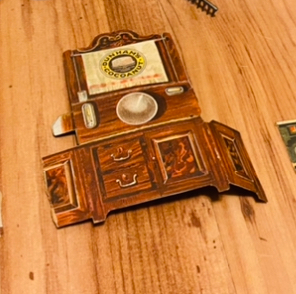
As promised, this is a closer look at the Dunham's Cocoanut Doll House furniture that belonged to Beth Neal's great-aunts. They would have received an envelope of lithographed, paper furniture along with their doll house. I do love the image of these enterprising little girls, pooling their resources, to acquire their doll house. 

Notice that each piece of doll house furniture is emblazoned with the Dunham's Cocoanut logo or medallion. This is worth keeping in mind if you are ever searching through an antique shop and come across any of the pieces. My guess is that lithographed paper furniture that is missing Dunham's brand name would not be one of their pieces. 

An overview of all of the paper furniture pieces:


The bed with coverlet and lace embellished pillows. Note the Dunham's Cocoanut medallion in the headboard:


The dress and the bed would have been intended for the top-floor bedroom. Notice the hairbrush and hand mirror: 


A rocking chair for either the bedroom or sitting room. Since there was a settee that matched the rocking chair, they were probably intended for the sitting room.


This appears to be a sideboard for the dining room, complete with trays, a chafing dish, and a coffee pot or teapot. There was probably also a dining room table. 


A cast iron, wooden cook stove for the kitchen:


Also for the kitchen, a prep table, where there seems to be a pie in progress:


And finally, a washstand that might have been placed in the bedroom. Notice that the Dunham's Cocoanut brand name is on the hand towel rather than on the washstand itself: 


Saturday, February 26, 2022

Interior of Beth Neal's Dunham's Cocoanut Doll House

  ©  Kathy Duncan, 2022

This post is long overdue. I am going to focus this post on the interior of Beth Neal's Dunham's Cocoanut Doll House and on the original paper furniture.

Let's start with a peek at the kitchen, which is on the ground floor:


It does not look much like modern kitchens because kitchens in 1903 consisted of freestanding furniture rather than built-ins. The lithograph shelves on the left held little lithograph packages of  Dunham's Cocoanut. 

The second floor may have been intended as a dining room: 


This is Beth's favorite room because of the moose head! I find the aquarium fascinating. I guess it held goldfish. I'm not sure what other fish would have thrived in water without an oxygen pump. It's interesting to think that people might have had such large aquariums in their homes. Even though this room has a very masculine, outdoorsy feel, the dish rack on the wall makes me think it is a dining room.
The third floor seems to be the sitting room or parlor: 


The sitting room has a much more feminine feel - from the upright piano to the frilly lace curtains.

The top floor was the bedroom:


The colors in this top-floor bedroom seem the most vibrant. The rug is especially well preserved as is the blue striped wallpaper and paintings on the wall. Notice that true to the time period, the paintings are suspended from the molding. It also looks like the upper portion of the bay window was stained glass.

The original set of paper furniture is the crowning jewel:


These pieces are in very good condition even though some bits have flaked off. Each piece of furniture bears a Dunham's Cocoanut medallion. The furniture is deserving of its own post, and I will try not to wait so long to post the next entry about them. 

Tuesday, November 16, 2021

Beth Neal's Dunham's Cocoanut Doll House

  ©  Kathy Duncan, 2021

When Beth Neal went looking for more information on her Dunham's Cocoanut Doll House, she found my earlier blog post about them here, and she contacted me. Beth found her dollhouse in her parent's basement. It originally belonged to Beth's great-aunts who lived in Eustis, Florida as children. Beth does not know how her aunts acquired their dollhouse. Did they pool their resources and win if from a local merchant? Was it a form of payment to their father, who owned a jewelry store in Eustis?

Beth graciously sent me pictures of her dollhouse and agreed to allow me to share them here.

As you can see, Beth's dollhouse is in very, very good condition. The lithograph colors are still vibrant and relatively undamaged. Many of these houses have worn or missing lithograph paper, color loss, water damage, or mildew. 

For this post, I would like to take you on a tour of the house. In the next posts, we will look at the individual rooms, furniture, and inhabitants of this little house.

The house itself is a four-room, four-floor construction. Like the other houses I've seen, the edges of the house are painted orange, and I wonder if this was a company color. 


The lithograph sides of the house are also in very good condition, and the windows are clearly defined. 


Right Side


Left Side


The back of the dollhouse reveals that it was made with two pieces of wood. The split in the wood accounts for the tear line in the interior lithograph paper. After looking at pictures of several other Dunham's Cocoanut Doll Houses, this seems to have happened to all of them. 

Back


The Dunham's label on the back warns the recipient that this is the back of a dollhouse and that the crate is meant to be opened from the front. 


Back Label


Both ends of the dollhouse were embossed with the Dunham label. This is the top. It shows its age and a little wear.


Top


The bottom of the dollhouse, however, is vibrant and shows little wear. It must look very much the way it did the day it arrived at the shop where it was displayed. Notice that the word Cocoanut is in orange like the front edges of the house.

Many little girls must have drolled over this house and dreamed of owning it.


Bottom

Sunday, September 5, 2021

M. Jumeau Dolls, 1867

  ©  Kathy Duncan, 2021

I am far from an expert on Jumeau dolls. However, I find it very interesting to read period pieces on the manufacturing of early dolls.

Just prior to the publication of this piece, the Jumeau dolls had received a Silver Medal at the Exposition Universelle, the second world's fair held in Paris from April 1 to November 3, 1867. Their award that year no doubt sparked the publication of this piece which was lifted in part, with the paragraphs rearranged, from Mr. Bartley's Reports on Toys in the Paris Universal Exhibition 1867 Presented to Both Houses of Parliament by Command of Her Majesty. The focus on this English report of Jumeau's fashion dolls was that their elaborate dress made them unsuitable as playthings. There also seems to be some English indignation that the French dolls had won awards as dolls when their role as toys was secondary to their role as fashion plates although Bartley concedes that the heads are better and more unique than a simple china head.


Commercial Bulletin
Boston, MA
Saturday 23 November 1867


Transcript: 

Doll Making in Paris

"The manufacture of dolls is a very interesting process, though difficult to witness, owing to the various portions being generally carried on in different places. M. Jumeau, at 8 Rue d'Anjou au Marais, is one of the largest makers in Paris. He employs many hands, the greatest number being women, who are scattered in all parts of the city. The heads of his dolls are porcelain, and most of the bodies of sheepskin, stuffed with sawdust, except the hands, in which iron fittings are inserted, to enable the fingers to be moved easily. The process of cutting the leather is peculiar, being done by hand, with an iron stamp set in boxwood. The stamps, of course, vary in size, and several of different shapes are required for each doll.

When the leather is cut, the next process is to sew the parts together: this requires a regular apprenticeship, more peculiarly for the fingers, which need great care; after the various parts are sewn up, the body has to be stuffed and the limbs attached. The doll is then ready to receive its head; the manufacture of this part is totally distinct, and similar to that of ordinary porcelain. Cheap china heads and shoulders are all in one piece, and their eyes are simply painted; while the superior description are made separate from the neck and shoulder, to enable the head to move on a sort of joint, and glass eyes are inserted into the sockets left for this purpose. The last thing is the hair, and in this English makers excel the French. At this manufactory, owing to the heads being of china, the hair has to be put on as a wig, and cannot be inserted so naturally as in a wax head. Human hair is rarely, if ever, used in Paris, the general material being mohair for the best and a sort of fur for the cheaper style of doll.

The dolls, when completed, have to be dressed, and this process varies with the fashion; it would not do for a French doll to be behindhand in this respect. At M. Jumeau's establishment the same style is not used for more than a month. All the dolls' clothes are made on the premises, where a roomfull of young women is continually at work for these small fashionables. At the same time, it must be borne in mind that the French doll manufacturers have an object in thus dressing up their dolls, which is more important than their use as toys. They are sent to India, and all parts of the world, to serve as types and models of the Paris fashions; for on arriving at these places their first use is to be studied by the dressmakers; and when useless to them in this respect, they descend to the children for toys. These two uses in which French dolls are thus subjected, though, perhaps, an economical commercial arrangement, are quite opposed for the production of a doll suitable for the hands of a child, and this accounts for the total unfitness of most of those expensive ones that were exhibited at the Exposition, and which figure in the shop windows on the Boulevards."

The following paragraphs, which were omitted from the newspaper version above, leave little doubt that Mr. Bartley found the Jumeau dolls in the exhibition lacking. Bartley does concede that the doll clothing manufactured by Juemeau are "good toys" and "popular." 


Transcript: 

"The dolls exhibited by M. Jumeau are not his best specimens, nor can they be looked upon as giving a fair idea of his general style. Some of the smaller ones which are put in the less attractive parts of the stall are good. The three figures at the back of the case are got up in an elaborate and brilliant manner, representing ball costumes; but they are certainly not commendable as toys, or suitable to the taste of English mothers for their children. The small boxes of dolls' clothes, or the dolls' trousseau, are good toys, and from the variety exhibited, and the very large numbers manufactured, it is evident they are popular.

M. Jumeau has not exhibited any of his mechanical dolls, saying "Mamma" and "Papa," and crying when laid down. These specimens are well worthy of a corner in the Exhibition. He also arranges the works, and dresses a large number of walking dolls, the patent for which is American, and for this reason he does not exhibit them."


Monday, June 7, 2021

Enter - The Kewpies

   ©  Kathy Duncan, 2021

In August 1910, The Woman's Home Companion announced that Rose O'Neill's Kewpie characters would be introduced to their audience for the first time in September.


By Christmas 1913, Kewpies were all the rage and were being marketed in every form imaginable including a sugar candy figure.


The Jacobs' Stores in Atlanta, Georgia carried a fill line of Kewpie products, including dolls which were introduced for the first time that year. In 1913, Kewpies ranged from 4 1/2 inches to 11 inches. Although we think of Kewpies as being blue-winged, naked cherubs, some were dressed. It is impossible to tell from the ad what materials these Kewpies were made of. Size seems to have dictated their price with the large 11-inch being the most expensive at $1.50, which translates to $40 in 2021.


Sunday, March 28, 2021

Nell Brantley, Doll Collector and Girl Hero, 1914

  ©  Kathy Duncan, 2021


On 23 November 1914, The Atlanta Georgian ran a huge photograph of Nell Brantley and her doll. She had won the doll in one of the newspaper's contests, but that is not why they were featured in the article.  The previous May, Nell's house at 152 Forrest Ave. in Atlanta caught on fire, and she was the first person in the household to realize they were in danger. Some accounts claim that she ran to her mother and reported the fire. Then she ran to a bedroom where her convalescing sister was and began carrying her nephews out of the house and laying them in the yard one by one. Another account claims she had one child climb on her back and grabbed the other two and took them all out at the same time, which would have been a staggering feat for a ten-year-old. In reality, she rescued two nephews and a niece all under the age of five or six. Then she returned to help rescue her mother and sister. Her older brother Emmet and a passerby named Clarence Williams were also involved in helping the adults get out of the burning house. Realizing that her little dog was still in the house, Nell returned for him and grabbed her six dolls, which were in a box under the bed. One account has her staggering out of the house with just the dog and returning for an arm full of dolls while another has her bringing the dog and box of dolls out at the same time. In both accounts, she battles through choking smoke to go back upstairs for them. An account, that was published just after the fire, related that she then turned back to reenter the house and rescue the canaries, but a fireman grabbed her and stopped her.

My mother pointed out that houses burned more slowly then, so Nell would have had plenty of time to rescue her family, dolls, and dog. Houses were made of wood and most of the windows were open all the time. Children were trained to hang their clothes with the hooks going over the rod so that they could grab their meager wardrobes on the way out.  

While the details of the event vary from account to account, the one constant is that Nell received a gold medal from the Ralston Hero Commission of St. Louis for saving the lives of her two nephews and niece. 

So far, I have only been able to locate one article from the time of the fire. 


This article was picked up from an Atlanta paper that originally published the account on May 23, 1914, which would place the fire on May 22.

Other papers later published a photograph of Nell and her little dog Togo. This one is from The Detroit Times of 3 June 1914. 


Nell's full name was Vera Nell Brantley. She was the daughter of Joseph and Mary Oma (Davis) Brantley. By 1910, her father was deceased. Most of the older children had moved out by the time fire. However, her older sister Johnnie Louise (Brantley) Sullivan and her three children were also living in the household. 

Nell had won her doll from The Atlanta Georgian newspaper, which ran a contest for boys and girls to win Christmas toys in 1913, specifically dolls and teddy bears for girls and tricycles, trains, and rocking horses for boys.  


Nell's name appears in the lists of children who were competing for prizes, evidently, she won one of the dolls. Given its large size, perhaps 30" or more, I think it would have been one of the more expensive dolls.

However, this was not Nell's first contest. The Atlanta Georgian frequently ran contests that involved getting "votes" that were tied to subscriptions and "votes" or points varied based on whether they came from existing subscribers or subscribers. 

One list of entrants reveals that little Nell Brantley was a "newsie" or newspaper carrier. 


In this contest from the spring of 1913, children were competing to win a Shetland pony and outfit, which seems to have varied from a pony cart to a saddle. Vera Nell Brantley appears in District No. 1 throughout the lists that were published as the contest unfolded. One list places her address as 31 Alexander, which is different from the address at 152 Forrest Ave, where the family was found a year later when their house burned. 

The Brantleys don't seem to have lived at 31 Alexander for long. 


The seven room house was for rent in December of 1912, and occupied a month later.


It is not hard to imagine an enterprising widow swapping her sewing skills for music lessons for her children. I believe that the occupants were Oma Brantley and family. 

For most of the Pony Outfit Contest, Nell Brantley's name appears as one of the top contenders in District one. Then about the time her name is dropped from the list this advertisement appeared.


I am not sure exactly how the Brantleys figured out this vote exchange would work to their advantage, but someone did the math and calculated that Nell would probably not be able to win in the newsie category, but that if they exchanged their votes, one of her siblings could win as a school child. This seems to have been within the rules. Shortly afterward, Nell's sister Helen Brantley appears on the contest list for District one, and she won. Of the dozen Shetland ponies to be given away, she would have the sixth choice.


Remember the prize was a Shetland pony and outfit. This was a much more complicated prize than a large doll. The pony would have had to be stabled and fed at great expense to a family that appeared to be struggling. So, why did they work so hard to win it, even going to the trouble and expense of placing an ad so that they could exchange votes?


It appears that the Brantleys never intended to keep the pony. It was put up for sale almost as soon as they gained possession of it.


By December of 1913, Nell was competing in District No. 4 in The Atlanta Georgian's Christmas toy contest. I think this is an indication that the family had moved, probably to the house on Forrest Ave. that burned later. 


In December of 1913, Helen Brantley also won The Atlanta Georgian's Great Want Ad Contest, which was a two-person tour to California. The Brantleys must have liked what they saw in California because the family eventually relocated there. 

In late May 1914, the house on Alexander St. was available to rent again, and I wonder if the Brantleys moved back there after the Forrest Ave. house fire.


Vera Nell  Brantley went on to have a brief career in California as a silent film actress in the early 1920s. 


Her films included, Darwin Was Right, Fast Fightin', Cyclone Saddle, and White Thunder. She was then married briefly to John Hugh White, and they had one son Jay Hugh White. I don't know if Nell was widowed or divorced.

Her next husband was "Buddy" Jackler. They were married for decades and lived in Palm Springs, California. Nell played golf often, and she and Buddy were occasionally photographed for the society pages. In the picture below, from 1978, Nell (Brantley) Jackler is the second from the left.