Sunday, May 29, 2022

Izannah Walker's Central Falls Neighborhood

      ©  Kathy Duncan, 2022

Newspapers provide information and stories that flesh out the life and times of people and add color to what is known about them. With that in mind, I researched Izannah Walker's immediate neighborhood during her residence there. Life on Illinois Street in Central Falls, Rhode Island, was filled with both excitement and sorrow. 

Izannah Walker probably took up residence in her house at 14 Illinois Street shortly after she purchased it in 1871. Even though the house number changed to 24 Illinois Street shortly after her death and eventually to 60 Illinois Street, during her lifetime, the house was number 14, so that will give the reader a rough idea of the proximity of these events.

By 1876, Pray's had opened a greenhouse at 6 Illinois Street, which would have been just down the block from Izannah, located near the intersection of Illinois Street and Central Street. Pray's offered cut flowers and was within a reasonable walk from the railroad depot. We learn from this advertisement that 30 trains a day arrived in Central Falls from Providence. Izannah was only fifteen minutes away from Providence if she traveled by rail. 


Shortly afterward, Pray's added a telegraph office to their services. That means Izannah could have easily walked down the block to send a telegraph to her family in Somerset, Massachusetts.


In 1882, curbing was added to Izannah's side of the street. 


Funerals were frequently held from the residents' homes on Illinois Street, and they would have also been social events. William Worden's funeral in 1883 was an elaborate and highly attended event. His residence was just north of the intersection of  Rand Street and Illinois Street.


Mostly, these funerals were for the elderly. It was not uncommon for there to be more than one funeral a year in the immediate neighborhood. Emily E. Burnham's funeral in 1883 would have been held in a house almost directly across the street from Izannah. 


Large birthday parties for the young were also neighborhood events. In 1884, fifteen-year-old, Carrie Vaslet's birthday party was attended by thirty-five of her closest young friends! It would have been a day filled with the happy sounds of singing and games. The Vaslets would have lived in a house on Illinois Street located between the intersections of Rand and Central.


A few months later, Izannah's own tenant, Catharine Trafton, died and the funeral was held from Izannah's house. Since it was a two-family house, the service was likely held from the Trafton's residence. Catharine Trafton and her daughters can be found in Izannah's house on the 1880 census.


That summer, the neighborhood was abuzz with the shenanigans of a flower thief who was creeping around Illinois Street near the intersection of Rand Street, stealing flowers from people's yards. It seems very likely that Izannah, the grower of Concord grapes, may have been one of his or her victims. 


A little more than a month later, a large party gathered in the evening at the residence of Alonzo Burt to see a night-blooming cactus. Burt's house would have been across the street from the old Pray's Greenhouses. It is easy to imagine Izannah and Emeline in that curious group of onlookers.


A few weeks later, the neighborhood was shaken by what many believed to be the aftershock of an earthquake that rattled windows and dishes.


That fall, the local Republicans paraded through Central Falls during the presidential campaign season. The streets were lit with small fires, the houses were decorated and illuminated, and the paraders carried torches. Some houses offered refreshments. A band accompanied them through a portion of the parade route, which crossed Illinois Street at the intersection of Summer Street. From the description of the parade route, it seems like they may have turned south at Illinois Street and traveled down it to Rand Street, then turned west at Rand and headed toward Dexter Street, and then south toward Cross Street. This would have taken them along the northern side of Izannah's house. If you like old maps, you can try to recreate the parade route here


In 1885, the funeral of Henry Pearse was held from the location of the old Pray Greenhouses. 


Also, in 1885, homeowners on Illinois Street were actively taking in boarders and advertising in the Providence newspaper.


By 1886 the neighborhood may have been in transition. A stray bullet, fired off by a gang of men at the intersection of Illinois Street and Central Street, passed through Timothy Vaslet's dining room window. This was the same home where a large, happy birthday party for his daughter had been held just two years before.


Finally, in January of 1888, shortly before Izannah's own death, James B. Taylor died and his funeral was held from his home at 4 Illinois Street.


Saturday, May 28, 2022

Izannah Walker's Central Falls House Revision

      ©  Kathy Duncan, 2022

Shortly after I posted about Izannah Walker's house on Illinois Street in Central Falls, Rhode Island, it became obvious that I would have to revise it. Another researcher told me that her research indicated that Izannah's house was at a different location on the block, and she was correct.

So what went wrong with my research?

After digging back through the City Directories, it became apparent that the houses on Illinois Street had been renumbered between the time that Izannah died in 1888 and the creation of the 1895 map that I was consulting.

At the time of her death, Izannah was living at 14 Illinois Street, where she had been living for over a decade. After her death, her friend Emeline B. Whipple continued to live in the house. Emmeline was there in 1888 when Izannah died.


However, the City Directory for 1889 shows Emeline at 24 Illinois Street:


Emeline Whipple did not move; the house numbers changed. Something similar can be seen with her neighbor Jabez W. Wilmarth, Jr. In 1888, he was at 12 Illinois Street:


In 1889, he was at 20 Illinois Street:


Wilmarth is more problematic, though. In 1892, he was at 22 Illinois Street:


Revisiting the 1895 map sheds a little light on the situation.


The house numbers beginning at the intersection of Central and Illinois on the west (left) side are 6, 10, 14, 18, skipped house, and 24. By 1895, 24 Illinois St was the former 14 Illinois Street and was the location of Izannah's house. Emeline was still in residence there in 1889. The house between 18 and 24 was skipped and is unnumbered. There is a numbering pattern going on from 6 to 18, with each number increasing by four. Then it goes haywire between 18 and 24. Logically, it seems like the unnumbered house would be 22, making Izannah's house 26. That sort of problem may be why the area was renumbered again in the 20th century. 


The unnumbered house is probably the former 12 Illinois street, where Jabez W. Wilmarth Jr. lived, and logically, it should have become 22 Illinois Street.

The problem must have arisen in part because of Izannah Walker's sale of a lot on Illinois St. to Jabez W. Wilmarth in 1885:


Valued at only $100, there were probably no buildings on the lot. A description of that lot reveals that she basically sold her southern side yard. The first corner of the lot began 100 feet south of the intersection of Rand and Illinois on the west side of the street. It then ran 60 feet south to Mark Monkhouse's property, then 153 feet west to land bounded by Julia Oldham's heirs, then north 63 feet with John Crenshaw's heirs on the west, then back to Illinois Street with Izannah's land bounding the northern side. 


Izannah had bought her property from John Crenshaw in 1871. 

I have not found Jabez W. Wilmarth, Jr. listed as the property owner of the original 12 Illinois St., which later became 20 or maybe 22 Illinois St. I would think that the lot he purchased from Izannah would have become 22 Illinois once a house was built on it. 

Emeline continued to live at 24 Illinois St until she moved to Providence in 1892:


In 1880, the census shows that Izannah had tenants, and my guess is that her house was set up as a two-family tenement like many of the other houses in her area. This would have provided her with an income stream separate from her doll business. After Izannah's death, the City Directory reveals that Emeline continued live with tenants and that Mrs. Eliza Whipple also resided with her.

It appears that after Emeline moved out in 1892, tenants continued to reside in the house. It is possible that Emeline moved out for purely economic reasons. She may have found it less expensive to rent a room and live off of the proceeds of the house. Since Izannah's will gave her estate on Illinois street to Emeline for her natural life, she would have been free to live in the house or rent it out. The will did not stipulate that she had to live in it continuously. 

On 23 May 1903, Emeline Whipple turned the property at the corner of Rand and Illinois over to Izannah's nephew, David H. Walker, in a quitclaim deed for $1.  

By 1903, Emeline was about 79 years old. Her reasons for signing over the property may have been purely practical. She had collected rents from the two-family structure for 15 years, which may have provided her with what she thought were enough savings to last the rest of her life. She may have also had some other income stream to utilize. She would have had no way of knowing that she would live for another eleven years. Additionally, she may have wanted to escape from the responsibility of maintaining the property, which would have been a challenge for an elderly woman. 

Then about six months later, on 29 January 1904, David H. Walker mortgaged the property to the trustees of the New England Southern Conference of the Methodist Episcopal Church for $1,500, which he was able to repay by 14 or 15 June 1905. 

David H. Walker had a son named David H. Walker, Jr., who was just starting school at Stanford in 1905, which may explain why he needed $1,500. However, Stanford may not have even been charging tuition at the time. Even if they had been, tuition would have been much less than this. I have seen statements that Harvard was charging $150 in the same time period. 

Then on the same day, 15 June 1805, Walker sold the property to Goldsmith & Wood, real estate brokers who purchased and rented tenements. 


It is odd is that Walker sold it for only $100. Surely a property worth mortgaging for $1,500 would be worth more than $100 on the same day the mortgage was paid off! 

Even though the paper got the name wrong, the sale of Izannah's house to Goldsmith and Woods was listed in the newspaper. Note that it was listed as being a two-family house: 


If you have noticed the three-day difference between the newspaper date on 12 June and the deed dates on 15 June, the explanation is that deeds often contain a filing date rather than a sale date. In many instances, deeds are filed decades after their sale date. Sometimes you can figure that out from the wording of the deed and sometimes you can't. 

In 1908, Jabez W. Wilmarth purchased property on Illinois Street from Goldsmith. Since Wilmarth is found living at 24 Illinois St. on the 1910 census, my best guess is that the property he purchased was Izannah's house. 

Once Wilmarth owned 24 Illinois St., he could squeeze in another house between it and the neighboring house to the south. Of course, he may have built on that lot prior to 1908. The result is the neighborhood as it looks today. Izannah's house is currently number 60 Illinois St., and 58 Illinois St. is located on what was once Izannah's southern side yard:


And Izannah Walker's house as it looks today:


When the house was sold in 1954, it was considered a single-family house with eight rooms. 


Saturday, May 14, 2022

Walker Cloth Dolls

     ©  Kathy Duncan, 2022

I am working on my revision for the location of Izannah Walker's house in Central Falls, Rhode Island. 

In the meantime, I thought I would share another advertisement for Izannah's dolls that was placed by E. W. Billings in the Providence Evening Press in Providence, Rhode Island in 1875.


This little advertisement suggests a couple of things. One, the business relationship between Izannah and Billings was ongoing. Two, her dolls were offered in May, a time of year other than Christmas -  in a time period when advertisements for dolls rarely appeared at any other time of the year. 


Saturday, May 7, 2022

Izannah Walker's House, Central Falls, RI

    ©  Kathy Duncan, 2022

Like most genealogists, I have several of my own personal rules, and they apply to my research into doll makers and quilters. One rule is to be open-minded and flexible. That means I am always prepared to make corrections to my own research. It also means that I don't slavishly adhere to accepted research conclusions drawn by other researchers. Another rule is to avoid making assumptions because they lead to false conclusions. That one I'm still working on. 

Warning!  It turns out that I identified the wrong house in this post. I will be writing an updated post soon with corrections. 

This post is intended to make a correction to my previous post about Miss Izannah Walker's Celebrated Dolls in terms of where her house in Central Falls was located, and my conclusion that it was no longer standing.

The existing nineteenth-century Central Falls, Rhode Island City Directories place Izannah Walker in a house at 14 Illinois Street as early as 1873, the year she received her patent. That means she was probably in residence there while she was working on her patent. At this point, I don't know when she took up residence there.


Izannah was still in residence at 14 Illinois in 1887, the year before she died. That means she was in residence there throughout the time period when she was making the post-patent dolls and supplying E. W. Billings with dolls for his trade. 


I incorrectly located 14 Illinois street on the east side (right side) of the street near the intersection of Illinois St. and Central:

Incorrect Location of Izannah Walker's House
Arrow Points to General Area of Her Previous Residence at 11 Jenks


This happened because I used Google Street View to look for 14 Illinois Street. It landed me in front of a house that it labeled as being 15 Illinois Street. That house does not have a house number on it. In fact, most of the houses along that street don't have house numbers. I went up and down the street, spun around several times, and even went around the corner. I probably made myself a little dizzy. Had I turned around and zoomed in on the house across the street, I would have realized that it is actually 15 Illinois Street. 

I've been bothered that I could not find a better period map. It bothered me so much that I stopped in the middle of another property-related search to try again. This time I had better, more accurate results.

I began by looking for a Sanborn Fire Insurance Map of Central Falls from the turn of the last century. I still have not had good luck locating Izannah's neighborhood on those maps but will keep trying. However, the internet shook loose a map of Central Falls, Rhode Island that was published by Everts and Richards in 1895. Here is Izannah's neighborhood with her house: 


Illinois Street was one block east of Madison Street. From the intersection of Central and Illinois, look on the west side (left side) of the street, where all the houses are evenly numbered. Lean in and squint a bit. The first house is 6, the second house is 10, and the third house is 14. It's an odd sort of offset-looking footprint with a small structure at the back, which could be a shed or a big chicken coop. Take a minute and look at the other structures in the neighborhood. Look at the footprints and the lot sizes. Not much has changed since 1895. This map was created seven years after Izannah's death. We could speculate that her house was still standing at that point and that Emeline Whipple was still living in it.

If you are having trouble spotting 14 Illinois Street, it is here:


My next step was to try and pinpoint the location of 14 Illinois Street on a current map. I was still faced with the frustration of the current houses being mostly unmarked in terms of house numbers. Google maps, however, came to the rescue anyway. This satellite view provided the house numbers for that area:


In case you can't see the house numbers on the rooftops, what was 6 Illinois St. in 1895 is now 14 Illinois street, 10 Illinois St. is now 24 Illinois St., and 14 Illinois St. is now 30 Illinois St. If you compare the footprints of the current structures with the footprints in 1895, they are mostly unchanged. 

If you are having trouble spotting the location of 30 Illinois St. aka 14 Illinois St., it is here:


My next step was to take the addresses on both sides of the street, including 30 Illinois St., as well as the houses around the corner, and investigate their build dates through online real estate sites. One was built in 1850, one in 1870, and one in 1880. The overwhelming majority, including 30 Illinois St., have build dates of 1900. That seems odd given that the footprints for many of them are the same now as in 1895. I know there were houses on these lots as of 1895. The odds that they were all torn down and rebuilt in 1900 seems unlikely unless there was a massive fire, and the rebuilds all used the same footprints as the original houses. Odd and unlikely. 

My feeling is that the original build dates are currently unavailable, and 1900 is a good epic number for an old house's build date. Poof, they were all built in 1900. 

My question was whether the house found at 30 Illinois St. has the same footprint as the house at 14 Illinois St. in 1895. At first blush, they seem different. Not quite the same, weird offset shape. It's more of an L-shape now?

A closer look at the rooftop suggests the original offset shape:


On Google street view, the front of the house shows the suggestion of an addition on the left:


Creep up the street with me a bit, and a side view makes that addition more obvious:


I would propose that this is very likely the house where Izannah Walker lived during the heyday of her doll-making business. The house is certainly large enough for two women to live comfortably and create dolls. Of course, it's also possible that Izannah was operating her doll-creating business at another location. 

So is there a way to know for sure? Yes, again, this project would need boots on the ground and an intense day among the Providence County, Rhode Island land deeds. A researcher would begin with the name of the current property owner. Then the researcher would go to the Reverse Index of land deeds for the present. It's possible that these are computerized. The current owner is the "grantee" (aka buyer). Note the name of the "grantor" (aka seller) on the deed. That name becomes the "grantee" in the next search to find out who the previous "grantor" was. That process continues back through time using the reverse index and checking land deeds until the research gets back to around 1915, following the death of  Emeline Whipple. At that point, a variety of names might appear as the grantor: Izannah's nephew David H. Walker, who was her heir or his lawyer, Charles Whitehall; Izannah's niece, Mary Helen Holbrook, who inherited the executor role from her husband but who also seems to have declined it in favor of Frank H. White. It is possible to continue all the way back to when Izannah purchased the property. 

Trust me, I would tackle it, but those records are not available to me online. Yet. 

Correct location of Izannah Walker's house:

Correct Location of Izannah Walker's House


I would beseech any Izannah Walker fans who are reading this to drive by, admire, and sigh a little but don't trespass and don't make it weird for the current property owners. 

Friday, April 15, 2022

Miss Izannah Walker's Celebrated Cloth Dolls

    ©  Kathy Duncan, 2022

The charming dolls made by Izannah Walker are my heart's desire. Or a reasonable reproduction. In reality, I can't afford to have either one on my bucket list. Researching Izannah and her dolls, however, is well within my budget.

I do not have access to any pictures of Izannah's dolls that I can post here; however, if you have never seen her dolls, please take a moment to view them on Paula Walton's blog or Dixie Redmond's blog

I set out to research Izannah in the same way that I researched the quilter, Jane Stickle. This time, I am working through the lens of a genealogist who loves Izannah Walker dolls. My intention was to compare what is known about her to what the available online records reveal. So far, I'm pleased with the results. If you are an Izannah fan and enjoy reading every tidbit about her that you can find, grab a cuppa and tuck in. This might be longish. Much of it you may already know, but I promise there is "new" information as well. And perhaps a paradigm shift in your thinking about Izannah's doll production.

My first step was to check for Izannah Walker on the Family Search's shared family tree. I found her there, but no one had ever attached any census records to her. That seems odd, but Izannah's name makes it a challenge to find her in records. I attached the following census records to her: 1850, 1860, 1865, 1870, 1880, and 1885. Additionally, I had to add Izannah's aunt Jane Hellon (Swasey) Hintz to the shared family tree, and attached census records for Izannah's sister Jane H. Walker. You can view all of these original census records yourself if you will create a free Family Search account. Then follow these i.d. number links for each woman: Izannah Walker L265-881, Jane H. Walker MV3Z-HM2, and Jane H. (Swasey) Hintz G6P5-4FZ.

Izannah F. Walker was born in Bristol, which is documented on the 1885 Rhode Island census. The confusion begins over trying to determine if she was born in Bristol, Rhode Island or Bristol County, Massachusetts. The 1885 census says Massachusetts, so it would be Bristol County, Mass. However, other census records also record her state of birth as Rhode Island. I do know that her father Gilbert Walker was frequently placing advertisements in the Providence, Rhode Island newspapers, which noted that he was in Somerset, which is a town in Bristol County, Mass. Izannah's age varies widely from census year to census year as does her sister's age. On several censuses, Izannah's age would have placed her birth year closer to 1820 than 1817. In searching for individuals on the census, keep in mind that census information is only as reliable as the person providing it and might be provided by proxy. In other words, one household member might provide information for everyone. Even a neighbor could provide information if no one was at home that day. To find Izannah on the census, I widened the bracket for her birth year and varied her state of birth. I identified her by other occupants of her household - family and friends.

We know from various secondary sources that Izannah's parents died when she was young. Her mother died in 1824:


And her father died less than a year later: 


I believe that at the time of Sally and Gilbert Walker's deaths, the family was living in the vicinity of Bristol, Rhode Island. Tradition tells us that the Walker orphans were sent to live with relatives in Somerset, Mass. Keep in mind that Providence County, Rhode Island, and Bristol County, Massachusetts "border" each other even though they are also separated by a waterway. Traveling back and forth between the two locations would have not been a problem. People in that time period traveled much more than we give them credit for.

The 1850 census locates 28-year-old Izannah F. Walker in Somerset, Bristol County, Massachusetts, living in the same household as her aunt Jane Hintz, age 54; her uncle Robert Swasey, age 60; and her sister Jane H. Walker, age 30. The only household member with an occupation was Robert Swasey who was a painter. It's impossible to know from the census what type of painter he was. House painter? Mural painter? Portrait painter? Did he teach the Walker sisters and their aunt the painting techniques that they used on their dolls or was he the source for their oil paints? 

Edit: Jane H. Hintz can be found on the 1855 census for Bristol County, Massachusetts, living with her brother Robert Swasey. However, I have yet to find Jane H. Walker or Izannah F. Walker. Izannah may have been in Rhode Island by this time, so she would not have been included in the Massachusetts census. There was an 1855 for Providence, Rhode Island, which is missing volumes. I searched it page-by-page, but did not find Izannah F. Walker, Jane H. Walker, Mary C. Bragg, or Emeline Whipple. Either the pages they were on are missing, or they were not living in Providence, RI at that time. 

Two delightful, circa 1855 photographs feature little girls with their Izannah Walker dolls. Both girls were residents of Providence County, Rhode Island which argues for Izannah having made her move to that area by 1855ish. The girls were Clara Eady and Mary Ella Jenks. Of the eleven or so period photographs that I have found of little girls with their Izannah Walker dolls, only these two girls have been identified. Additionally, future doll maker Martha Jenks (Wheaton) Chase, who was born about 1851 and was a resident of Pawtucket, Rhode Island, received an Izannah Walker doll as a young child.  

Izannah was definitely in Rhode Island by 1860, when she appeared on the census in the township of Smithfield in Providence, rooming with 53-year-old Mary C. Bragg. She was likely to have been living in the village of Central Falls, which is located within the township of Smithfield. On this census, Izannah is listed as being 40 years old, which would shift her birth year to 1820. One extremely interesting detail is that Izannah owned $500 worth of real estate. That land deed might shed some insight into the year that she arrived in the area. Many are under the impression that women did not own property in their own names and that their property was owned by men instead. That is true of married women and daughters. Their property was legally held and controlled by the men in their lives - husbands and fathers and sometimes brothers. Never-married women and widows, however, did own property in their own right. It's one of the primary reasons why widows with property inherited from their husbands often did not remarry. Izannah Walker, as an unmarried woman with no father to dictate her business, was a free agent. 

The 1865 Rhode Island state census for Central Falls, Smithfield township, Providence County, Rhode Island, is the only one that lists Izannah F. Walker as a doll maker:


In 1867, Izannah was living at 11 Jenks in Central Falls, RI. 


On the 1870 census, 50-year-old Izannah Walker was rooming with her 44-year-old friend Emeline Whipple in Providence, RI. They seem to be boarding in the Martin household. This time Izannah is "keeping house" while Emeline is listed as a "doll maker." Izannah does not have any real estate at this time, but does have $200 in personal property. Personal property on the census means portables. Everything we know about Izannah indicates that she was in the doll business at this time. Emeline could have been participating in any phase of the process: body making, sewing clothes, or, painting - or possibly all of these. It is extremely interesting that a significant number of men in the neighborhood are listed as machinists. Any one of them could have helped Izannah in developing her doll manufacturing device. She was surely working on it during this timeframe. I had thought that I might find other women listed as doll makers and that would indicate that Izannah might be employing them. I did not find any nearby, but I did find dressmakers and seamstresses living in the vicinity. They may have been participating in Izannah's doll making, it's impossible to say.

While it is possible that Izannah received help from Reuben Bates, who was likely the pattern maker who crafted her doll head molds, she would have also been surrounded by neighbors who could have also contributed their knowledge. 

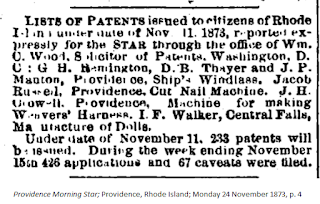
We know that Izannah applied for her doll manufacturing patent in 1873. The PDF for Izannah's patent was created by Dixie Redmond. When the patent was issued, there was a notice in the local newspaper. Note that in this notice Izannah is referred to I. F. Walker. Initials were popular for men's names and concealed the identity of women. When researching with old newspapers, remember to search by just the individual's initials.


One year later, during the Christmas season, E. W. Billings of Providence, RI published an advertisement solely devoted to promoting Izannah Walker's dolls. Note that E.W. Billings is offering the dolls wholesale, which suggests that he is selling them to other merchants although he would probably also be selling them to individuals. Significantly, he states that he has been Miss Walker's "agent for so many years." That suggests that he was carrying her pre-patent dolls for at least a few years. That would seem to include the year when Izannah and Emeline Whipple were on the 1870 census, and Emeline was the "doll maker" of record. Could two women alone supply a wholesale doll trade of enough significance to warrant an exclusive advertisement four short years later? I would contend that this must have been a larger operation than two individuals could keep up with. Izannah must have been employing others in some capacity. It's possible that her aunt Jane Hintz and sister Jane H. Walker were participating from a distance in some capacity. It's even more likely that Izannah was employing women in her area. 

Unlike the toy trade now, dolls and toys were mostly advertised and stocked in shops during the Christmas season. No doubt, Izannah and Emeline spent the whole year preparing for Christmas sales. 


I am taken with E. W. Billing's terminology: "Miss Walker's Celebrated Cloth Dolls" which were also "The Everlasting Cloth Doll." Everlasting is a term that I tend to associate with Greiner dolls. 

So far, I have not found any references to Walker's cloth dolls in E. W. Billings advertisements prior to 1874. He did mention that he stocked cloth dolls, but only in a generic sense that he advertised china, wax, and rubber dolls. Walker's local notoriety, following her patent, may have resulted in this shift in his advertising for her dolls. 

There is no doubt in my mind that the advertisement above refers to Izannah Walker and her dolls. Seven years later, in 1881, the firm of E. W. Billings, headquartered at the Butler Exchange, was still the agent for Miss Walker's cloth dolls. This advert makes it clear that the dolls were offered for both the wholesale and retail trade. Note that the dolls were offered for the "reduced" price of $3.75. In 2022's U.S. currency, that would be close to $110. Or approximately, the same as purchasing an American Girl doll for the daughter of a comfortable middle-class family. Dolls at this time were sold both dressed and undressed, which dictated their price. The size of the doll also dictated the price with larger dolls selling for more than smaller dolls. Izannah's dolls ranged from 13" to 29". 


Also, in 1881, E.W. Billing's stated that he had "a stock of Miss Walker's cloth dolls this season, their chief merit consisting in their ability to stand rough usage and abandonment serenely." This is not unlike Izannah's description of her dolls as "easily kept clean and not apt to injure a young child which may fall upon it. It will preserve its appearance for a long time..." 


The Butler Exchange, where E.W. Billing's firm operated in Providence, Rhode Island, was an imposing structure that would have housed several businesses. It comprised a commercial block in a port city known for extensive trade. From this point, Izannah's dolls could have been purchased by merchants at a considerable distance from Central Falls. They could have been easily shipped by rail or by ship. 


E.W. Billings was Edward Woodman Billings of Providence, Rhode Island. Billings was a wealthy merchant who died in 1877. Evidently, the firm continued for several years after his death and continued its relationship with Izannah Walker. 

The importance of this business arrangement with E. W. Billings cannot be overstated. His business ledgers, if they still exist, would provide a unique insight into Izannah's dollmaking business. They would tell us when that business arrangement started, which we know was before 1874. They would reveal when it ended, which we know was after 1881. They would reveal how many dolls were produced for this trade annually and their destination. Were they sold to merchants? Who? And in what numbers? Were they sold to individuals? Who? How much was Izannah receiving for them? How much did they sell for other than the $3.95 figure mentioned in the advertisement? So much fascinating information would be contained in those ledgers. 

The reality of those old ledgers is like that of old dolls, many of them have not survived. They have fallen victim to fires, floods, and the trash heap. Consider the vast number of ledgers than have been pieced out page-by-page and sold for craft projects by individuals who failed to see their value as local history items.

If E.W. Billings' ledgers cannot be found, then the ledgers of merchants in Providence County, Rhode Island, and Bristol County, Massachusetts should be searched since they would have been most likely to stock her dolls. Where might those ledgers be? They could be in local archives at the county level or in the libraries of colleges or universities. They might be in museums or historical societies. They might be privately owned by families. They might also be in archives at the state levels. Probably, most of them have not been digitized and will have to be searched by hand. This will have to be done by a determined person on the ground in that area. Regrettably, I cannot be that person!

My contention is that Izannah Walker was running a small business of some consequence rather than a quaint little cottage industry that relied on individuals trekking to her door to purchase dolls for their daughters. Since she made dolls in several sizes, she would have had at least one mold for each size and possibly a press for each mold. That might have enabled her to have dolls of each size in production at the same time. The question is, how many dolls could a determined woman produce annually and for how many years?

Doll historians have probably underestimated the number of dolls that she produced in her lifetime. What could have happened to all those dolls? Floods. Housefires. Rodents. Trash heaps. We know of one that was rescued from a trash pile recently. Some of them may be hidden under repaint jobs. Many are probably privately owned by individuals who have no idea what they are. Some of them may still be languishing in attics or in storage. 

We know from family tradition, that Izannah dabbled in many things. In 1877, Izannah entered her Concord grapes in the Horticultural Society's Exhibition at Howard Hall.


On the 1880, Izannah Walker and Emmeline Whipple were living in the town of Lincoln in Providence, Rhode Island. In reality, they were still in Central Falls, which is a village in Lincoln. Lincoln was in the township of Smithfield.  The existing Central Falls City Directories firmly place Izannah and Emmeline at 14 Illinois street in Central Falls from 1873 to 1887.
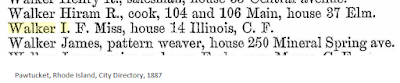


Currently, there is not a 14 Illinois street although there is a 15 and 16 Illinois street. None of the houses on that portion of the street today seem to date from Izannah's time.

A 1900 map of Illinois street in Central Falls does not differ much from a current map. The estimated location of Izannah's house is roughly in the red circle. Note that Jenks street was very close to Illinois street. Of course, there was also a Jenks Ave. If Jenk street was the site of her 1867 residence, then Izannah had lived in the same neighborhood for about twenty years. 


In 1885, Izannah sold a town lot situated on Illinois street. This would not have been her house.



I have seen some researchers question whether Izannah died in 1886 or 1888. I'm not sure where this confusion comes from. Her tombstone has the 1888 date although it may not have been erected until after Emeline Whipple's death in 1914. There was, however, a published death announcement for Izannah at the time of her death:



This death notice was difficult to find because of two factors. One Izannah's given name is split between two lines with a hyphen. Search engines that rely on computers using pattern recognition often cannot find a name that is divided in the middle, splitting it with a hyphen makes it even more difficult. Then look at the ink blob quality of the typeface. This also interferes with pattern recognition. What is that shape in Izannah's name that we recognize as a "z"? A computer might read that as an "r" or an "x." I did not find this when running a search for "Izannah F. Walker." Logically, it seemed like Izannah would have at least had a death notice. I finally found it by searching for just "Walker" and then reading each result for the day, including her supposed death and the days afterward. As you can see, she did, in fact, die on 15 February 1888 as is recorded on her tombstone. Her death notice was published two days later on 17 February.

Izannah was a woman of comfortable wealth at the time of her death. In her will, written in 1876, she left property that she had inherited from her uncle Anthony and aunt Jane Hintz to her sister Ann R. Smith. She left the remainder to her property in Somerset, Mass, and a few personal items to her sister Jane H. Walker. She made a small bequest to her old roommate Mary C. Bragg. Surprisingly, she left her doll patent to her brother David C. Walker. I had expected her to leave that to either her sister Jane H. Walker or her friend Emeline B. Whipple although it makes sense that she left it to her brother since he had children to pass it on to. He actually predeceased Izannah in 1885. She seems to have left the lion's share of her estate to Emeline B. Whipple, including the property on Illinois St. It was to go to charity after Emeline's death, but Izannah changed her mind and wrote a codicil to her will in 1887, leaving it to her nephew, the son of her deceased brother David C. Walker. She made no change to the bequest of her patent to her brother, so it would have passed to his heirs after her death. 
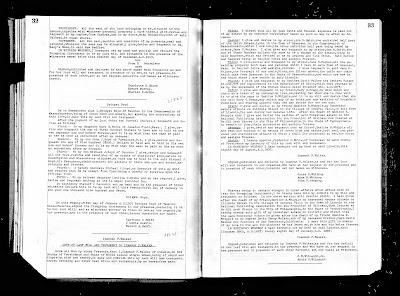


The final probate of her will was in 1914, following the death of Emeline B. Whipple. 


Following Emmeline's death in 1914, Izannah's Illinois street property would have reverted to her nephew David Henry Walker, who was a resident of California in the 1870s. At that time, we might expect that Emeline Whipple still had Izannah's doll press and molds. It's hard to know if those items would have passed to Izannah's family members or been sold at an estate sale. Did Emeline continue to produce dolls after Izannah's death? She likely had both the tools and ability to do that. Of course, she may have sent Izannah's tools to sister Jane H. Walker. 

Izannah Walker and Emeline B. Whipple are buried beside each other in Swan Point Cemetery in Providence, Rhode Island, where they share a tombstone. Her name and dates are also included as a cenotaph on a family stone in the Palmer Street Cemetery in Somerset, Mass. 

This post is dedicated to my lifelong friend, Kathy Quitberg, with whom I shared a love of all things dolls, quilts, and books.